case study
Treepz Super App: Unifying Fragmented Mobility Solutions
TL;DR
As a Senior Product Designer, I identified critical UX fragmentation across Treepz's mobility services. My research and strategic recommendations earned me a promotion to Product Design Lead, where I guided our team (2 designers, 1 UX writer) to create a unified super-app starting with our two core services: Business Treepz (B2B employee transportation) and Car Rental. Together, we delivered this transformation in a 3-month design and development cycle.
| Impact We Achieved (Phase 1) | Before (Q1 2024) | After (Q3 2024) | Change |
|---|---|---|---|
| B2B clients across 4 countries | 5 companies | 15 companies | +200% |
| Monthly employee commutes | 8K | 94K | +1075% |
| Engineering effort per new feature | Baseline | -28% (shared design system) |
"Finally, one app for our employee transportation and event rentals. Our HR team loves the unified admin dashboard."
Corporate client, Lagos
The Problem
A year after joining Treepz as a Product Designer, I discovered a critical problem across West and East Africa's mobility ecosystem. Commuters, corporate clients, event organizers, and travelers were juggling multiple fragmented platforms for their transportation needs: daily work commutes, employee transportation management, special event vehicle rentals, and airport transfers.
Through user interviews and data analysis, we found that 67% of our corporate clients were using 2-3 different transportation apps for their various needs. Event organizers spent an average of 45 minutes comparing services across platforms before making booking decisions. This fragmentation was costing us potential revenue and frustrating our users. I shared my findings with my line manager, and we agreed this presented a massive opportunity to create a unified mobility super-app covering all four transportation needs.
How We Conducted Research
Defining Our Audience
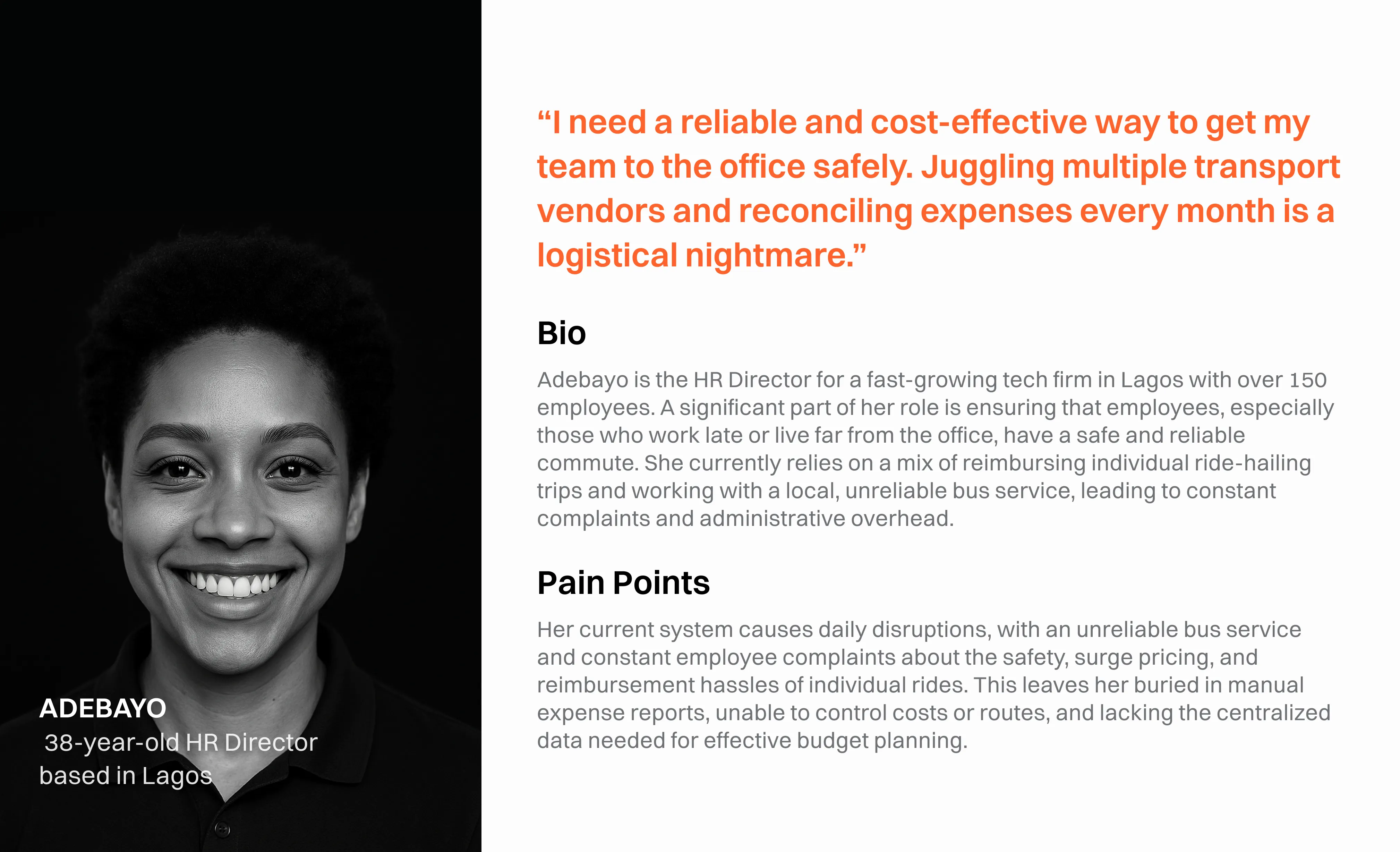
We analyzed data from Nigeria, Ghana, Uganda, and Kenya to identify four mobile-first groups: Daily Commuters, B2B Decision Makers, Event Organizers, and Airport Travelers. Each group had distinct priorities like reliability, cost control, service variety, and real-time tracking. All these segments rely on smartphones for payments and logistics, guiding our targeted design approach.
Our research revealed that 78% of business transportation decisions are made by HR managers and office administrators, while 65% of event transportation bookings come from individuals planning personal celebrations like weddings and family gatherings.
Data sources: Internal Treepz user analytics (Q4 2023), GSMA Mobile Economy Africa 2023 report, and local transportation surveys conducted in Lagos, Accra, Kampala, and Nairobi (n=50 respondents each city)
Our Research Strategy
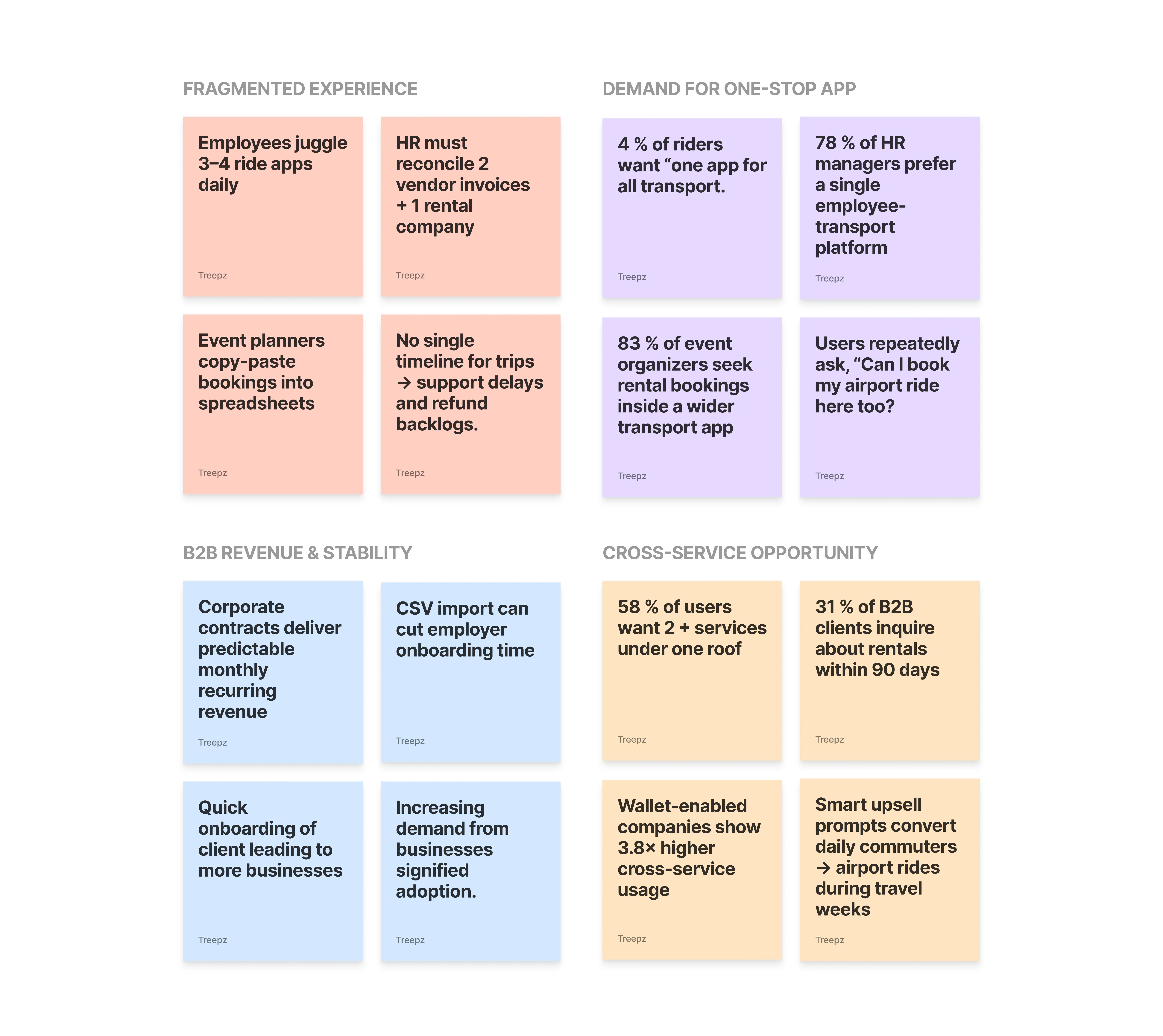
Using FigJam for collaborative affinity mapping, our entire team, including the PM, synthesized survey, interview, and analytics findings to reveal critical trends across all mobility segments.
Key insights from our research:
- 73% of HR managers wanted a single dashboard for all employee transportation
- Event organizers spent 2.5x longer on bookings due to platform switching
- 68% of users preferred wallet-based payments over per-ride transactions
- Cross-selling opportunities existed in 84% of our B2B client base
Solution and Opportunity
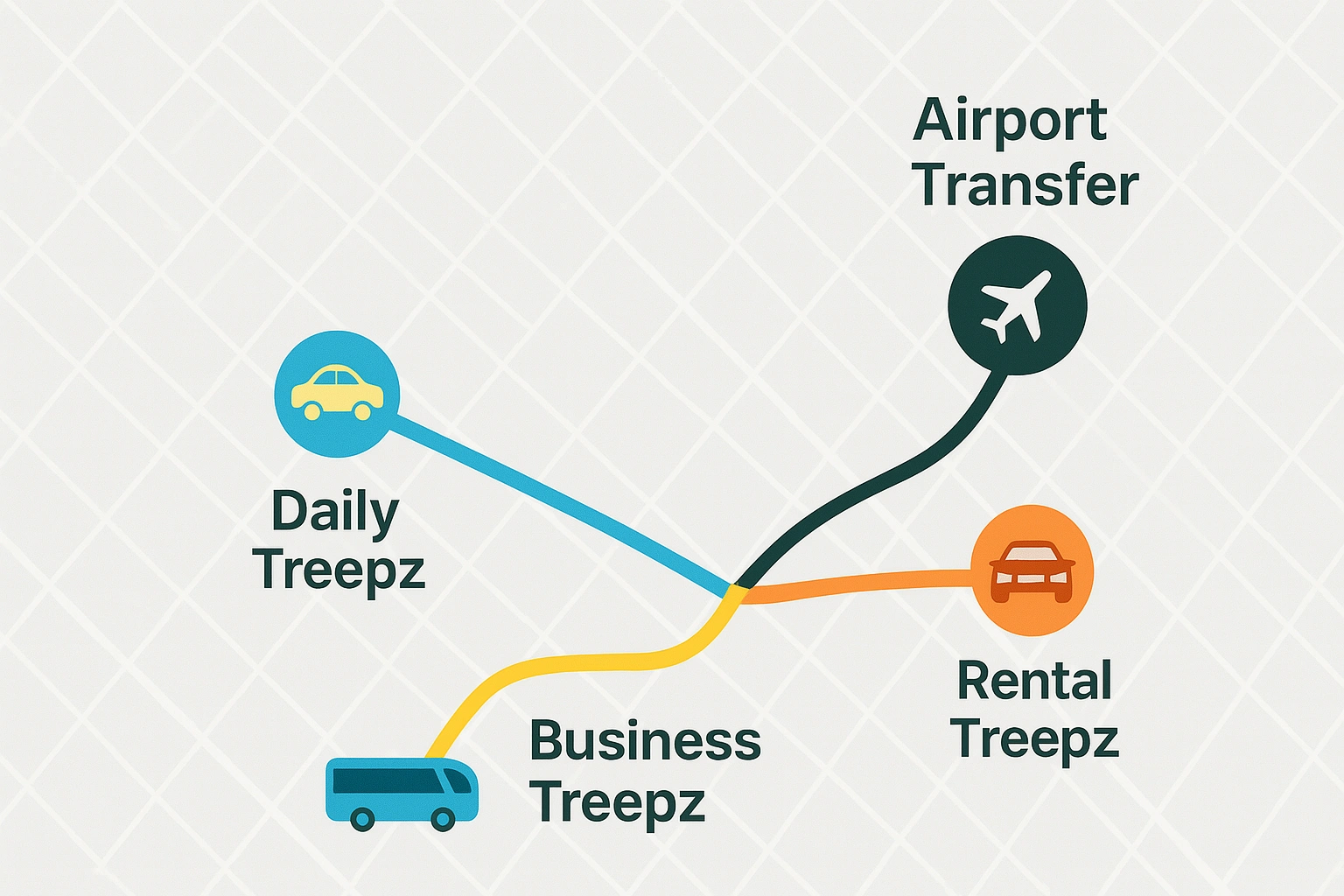
Our team's vision was a comprehensive four-service mobility super-app covering Daily commutes, Business employee transport, Car rentals, and Airport transfers. However, for Phase 1, we focused on implementing Business Treepz (B2B employee transportation) and Car Rental (event-based vehicle hire), with the full super-app architecture designed to seamlessly accommodate the remaining services.
To bring this to life, we held several brainstorming workshops. I facilitated these sessions with our design team and PM using FigJam to map out user flows and initial concepts. The Phase 1 goal was to design a system where:
- Employees could check in and out for work commutes seamlessly via mobile app
- HR teams could monitor employee transportation via Business Admin dashboard
- Event organizers could browse, book, and pay for rental vehicles in one flow
- Our ops team could manage B2B contracts, rental fleet, and prepare for Airport/Daily services from the comprehensive Treepz Admin
The Jobs To Be Done Framework We Established
In a workshop with our PM and the full design team, we synthesized our research into four core JTBD statements covering all transportation verticals:
"When I need to get to work every morning, I want reliable transport with predictable timing and pricing so I can arrive punctually without the stress of multiple booking attempts."
The Daily Commuter
"When I need to set up employee transportation for our growing company, I want one platform to onboard staff, track commutes, and manage costs so I can ensure reliable service without juggling multiple vendors."
The HR Manager
"When I'm planning my daughter's wedding, I want to browse, compare, and book different vehicle types for guest transport and couple arrival so I can coordinate everything seamlessly in one place."
The Event Organizer
"When I have a flight to catch, I want guaranteed pickup and drop-off with real-time tracking and driver coordination so I never miss a flight due to transportation delays."
The Airport Traveler
Designing the Platform Architecture
As a team, we architected Treepz as a multi-sided B2B/B2C platform with four interconnected products sharing one design language and backend. I led the overall information architecture, while the other designers focused on specific user-facing applications.
Our team created a token-based design system in Figma, which I had the privilege of naming the Wheels Design System. It is a scalable, token-based framework where I defined the token architecture, one designer developed core components, and our UX writer set the voice and tone guidelines, resulting in a native cross-platform experience that reduced engineering cycles by 28%.
Building the Core Experience
One of our product designers and I paired on the Mobile App. We ran weekly design critiques to refine the core flows, focusing on:
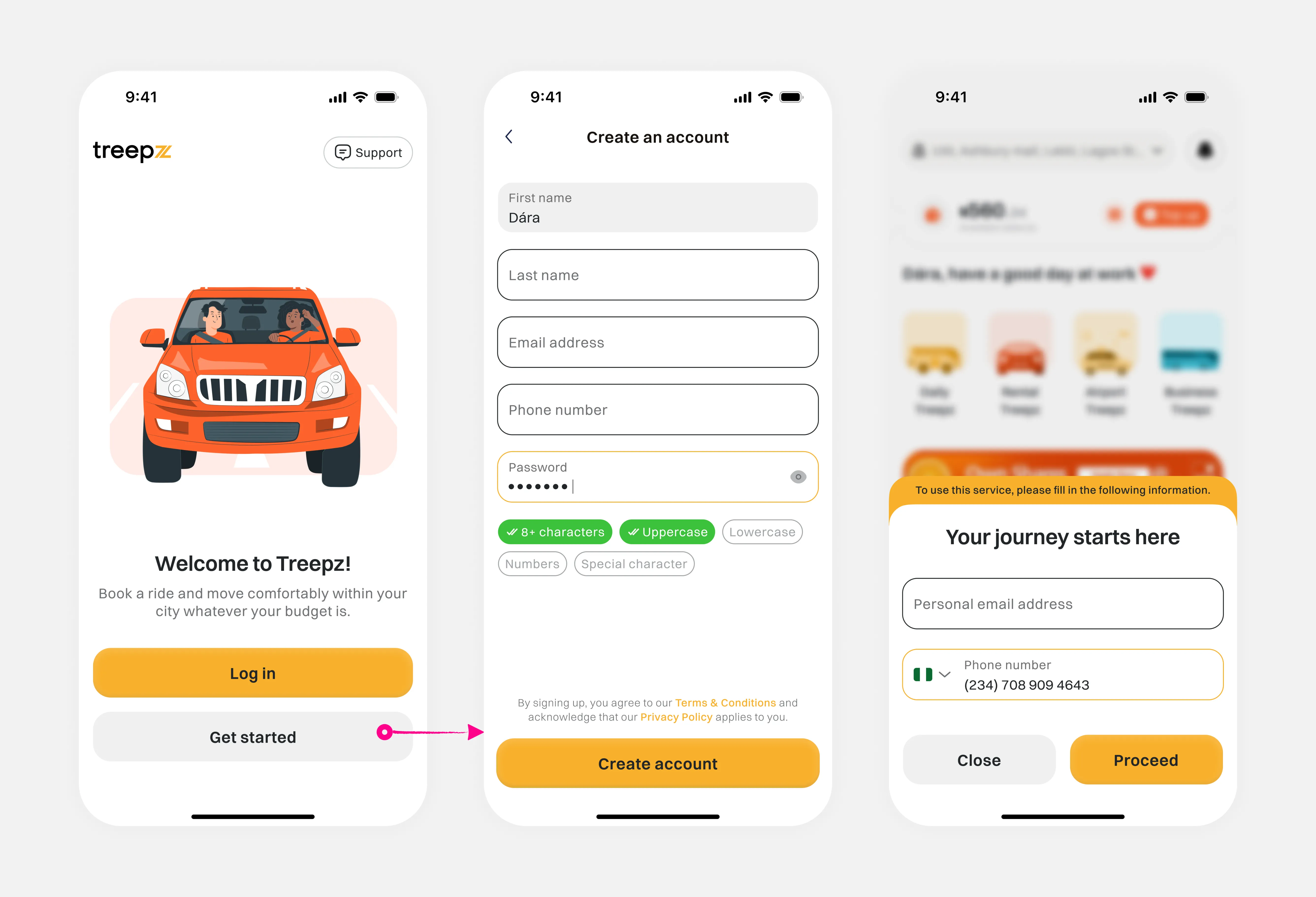
1. Onboarding
We recognized early that speed is crucial for platform adoption, so we streamlined the signup process to be both fast and intuitive. After introducing progressive disclosure and context-specific welcome flows, our onboarding completion rate increased from 62% to 89%.
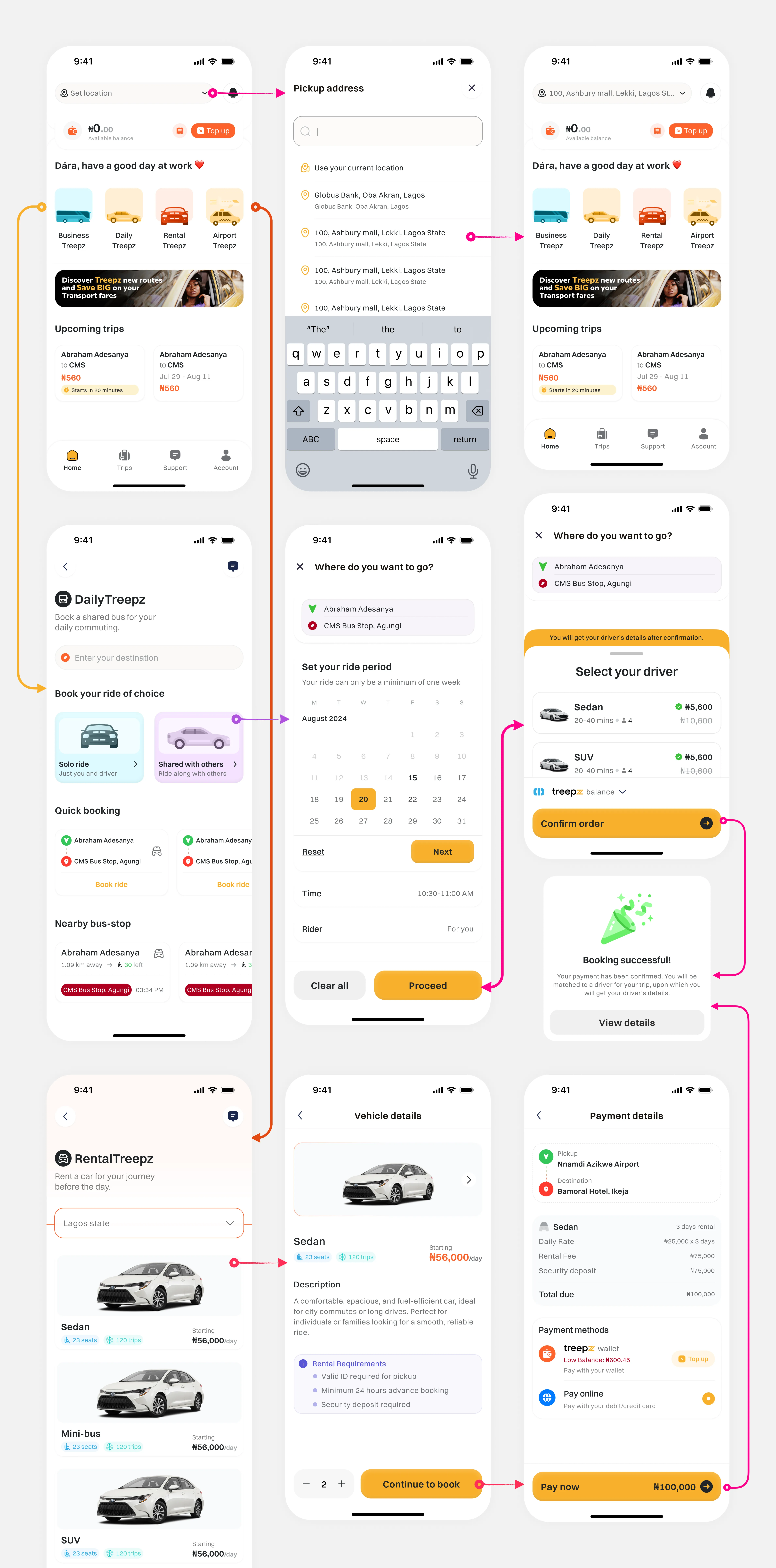
2. Ride Scheduling - Daily and Rental Treepz
In the mobility world, speed is everything. We have streamlined this process, reducing the number of clicks from six in the initial design to just two in the final version.
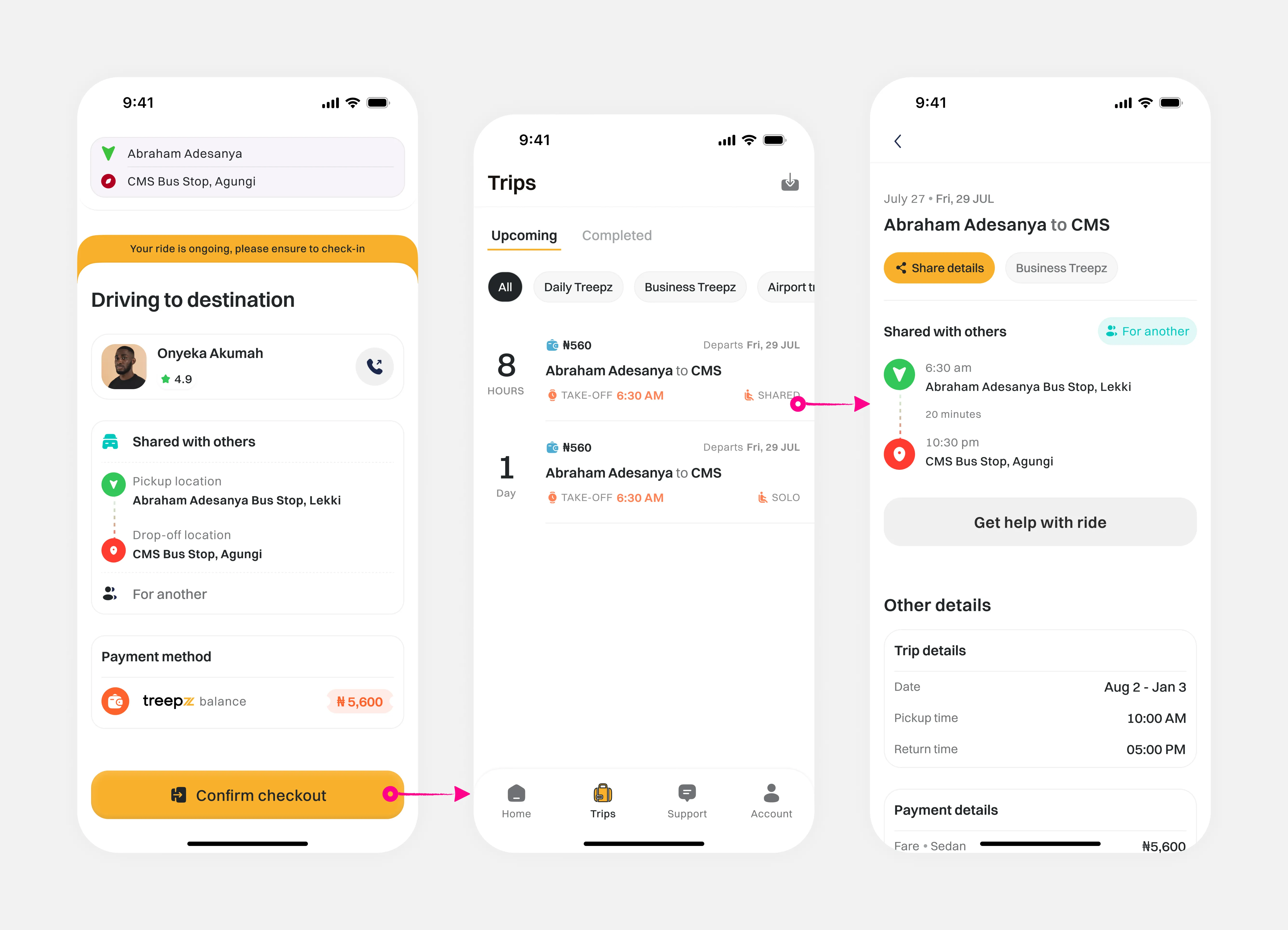
3. Business Treepz
We introduced a bottom sheet that displays specific information when a user accesses Business Treepz for the first time. During our pilot test, we realized that real-time check-in adoption was low, prompting us to iterate on the check-in scheduling feature with geofencing.
4. Trip Monitoring
Users can monitor estimated arrival times, call their designated driver, and access emergency support features, ensuring transparency and safety for both business commutes and event transportation.
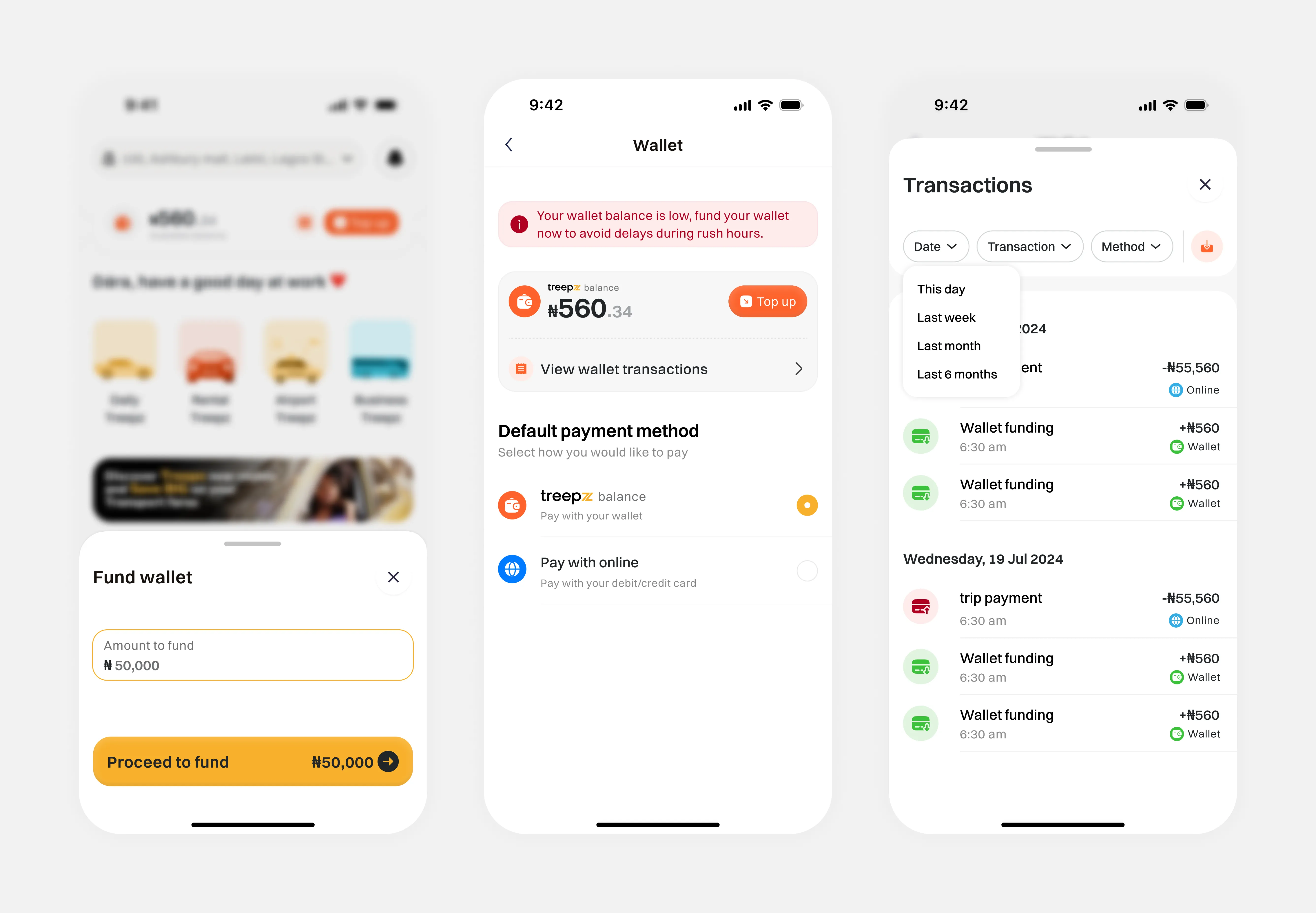
5. Wallet
Users can easily see their wallet balance on the homepage and fund it directly from there. We designed and implemented a comprehensive transaction history with robust filtering and report download options.
Mobile App for Drivers
1. Onboarding and Vehicle Documentation
By digitizing document verification and implementing clear progress indicators, we successfully reduced driver onboarding time from 5 days to just 2 days.
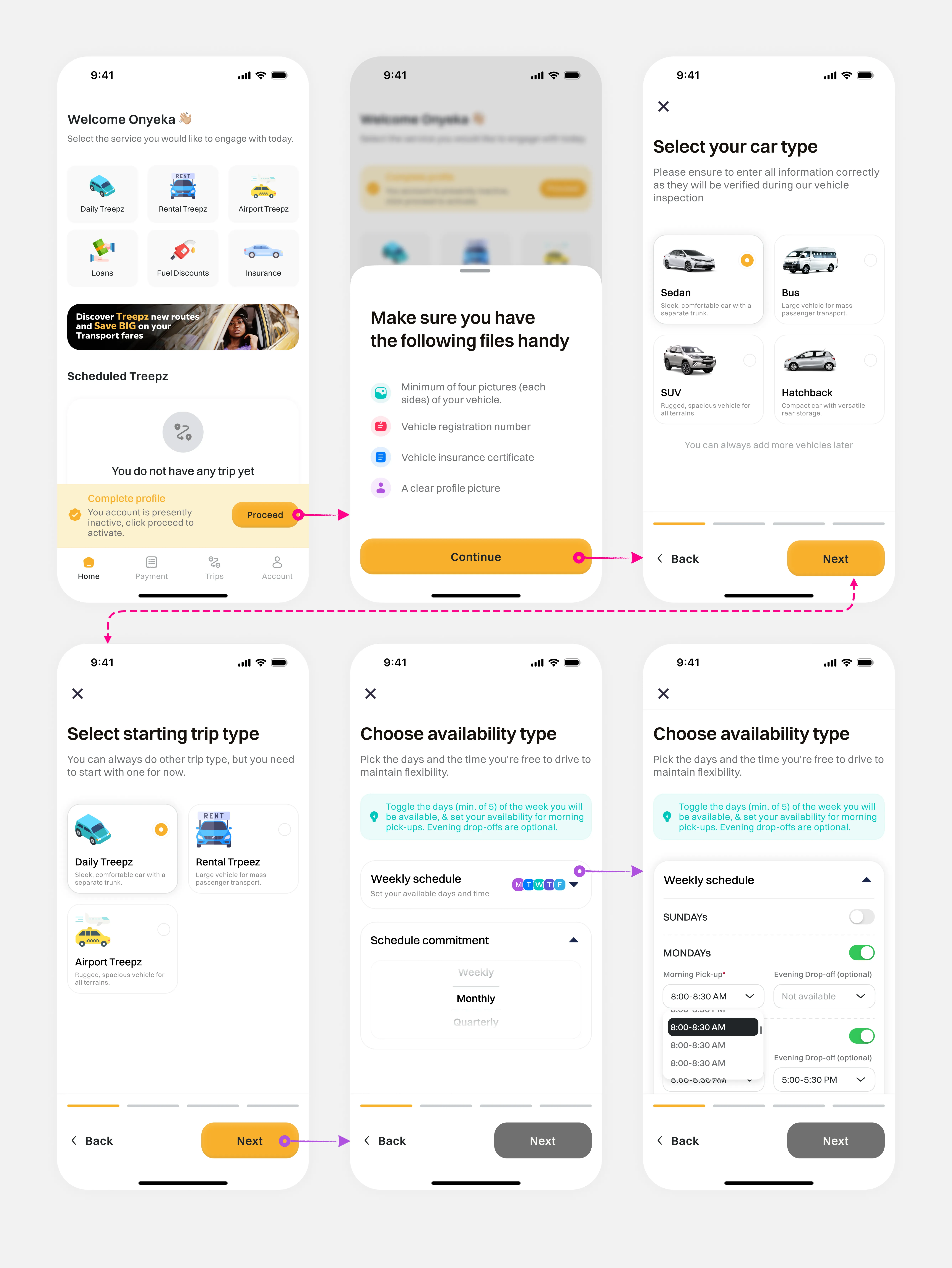
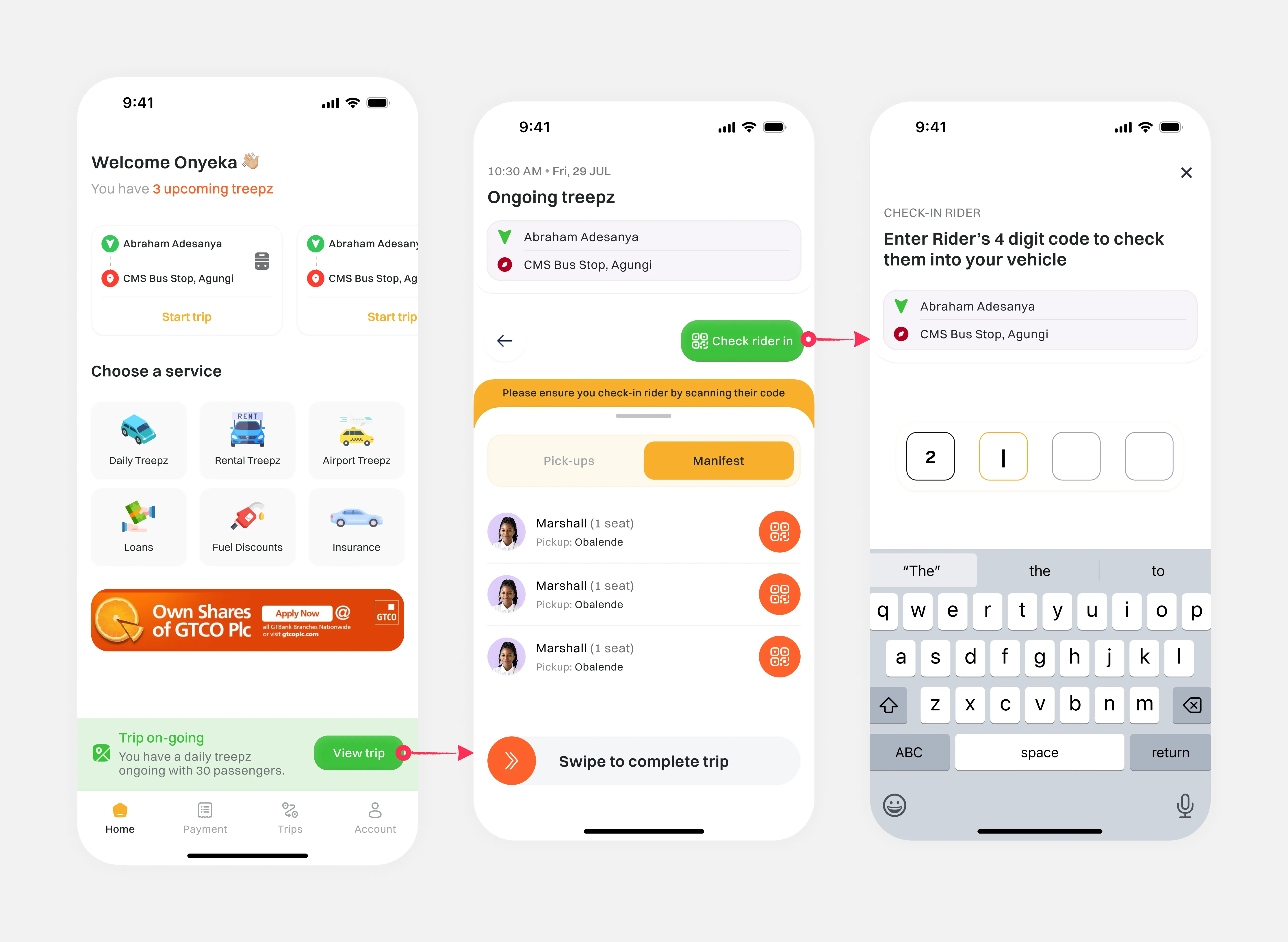
2. Trips
Once on the road, drivers land on a dynamic home screen displaying upcoming and ongoing trips with Pick-ups and Manifest modes.
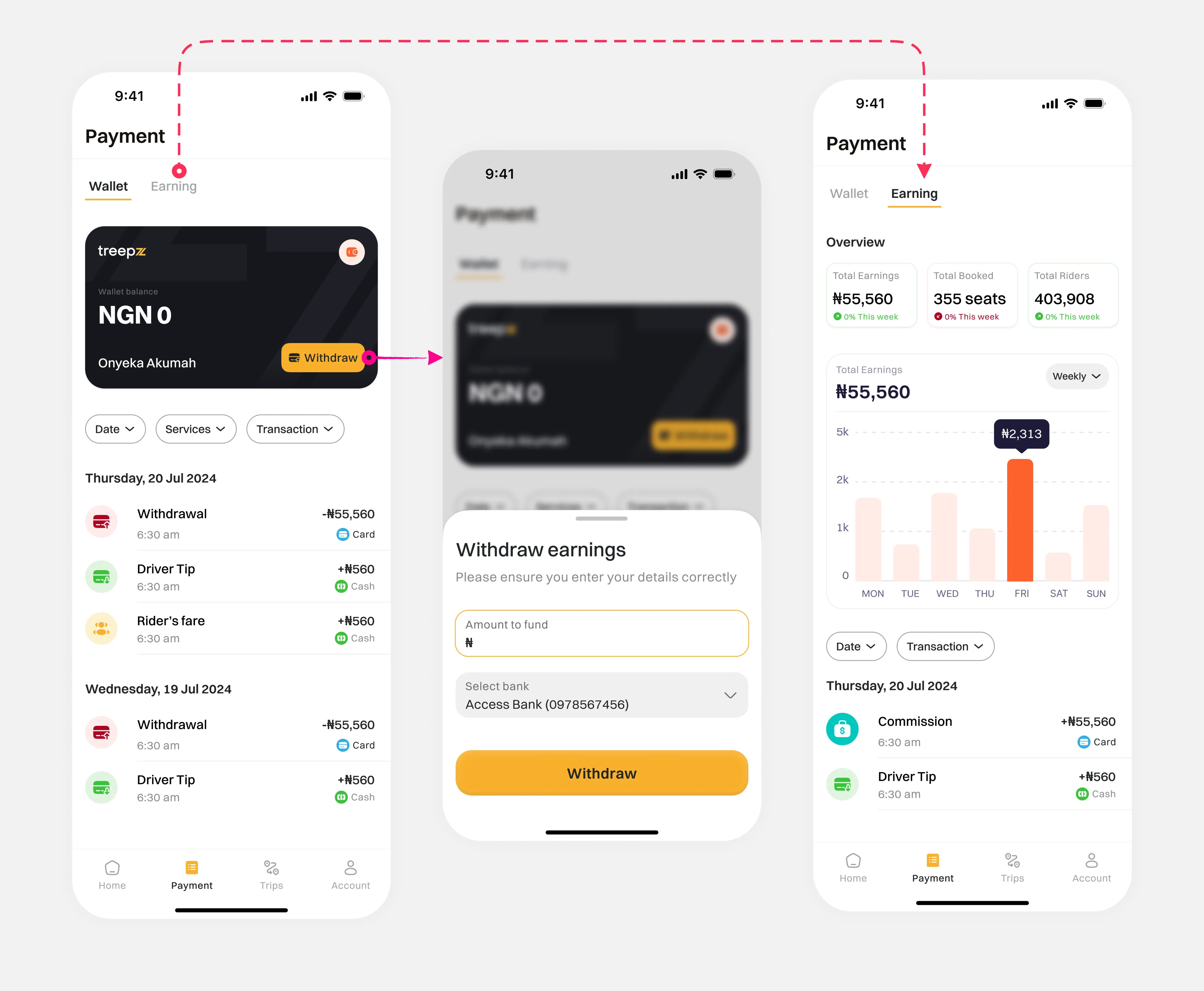
3. Earnings & Wallet
Under the Wallet tab, drivers see their real-time balance and a clear activity feed, allowing them to get paid in just a couple of taps.
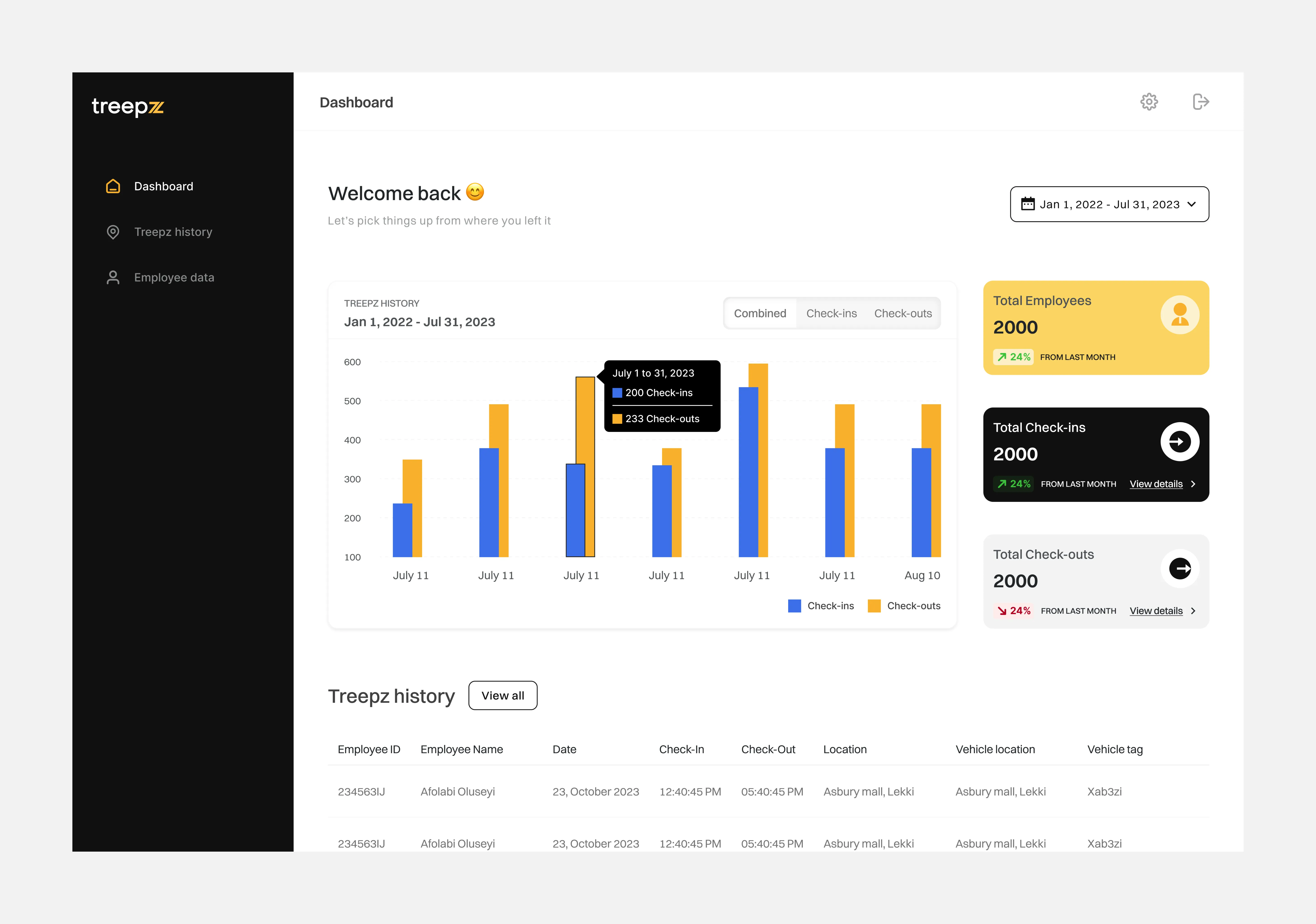
Business Admin Dashboard
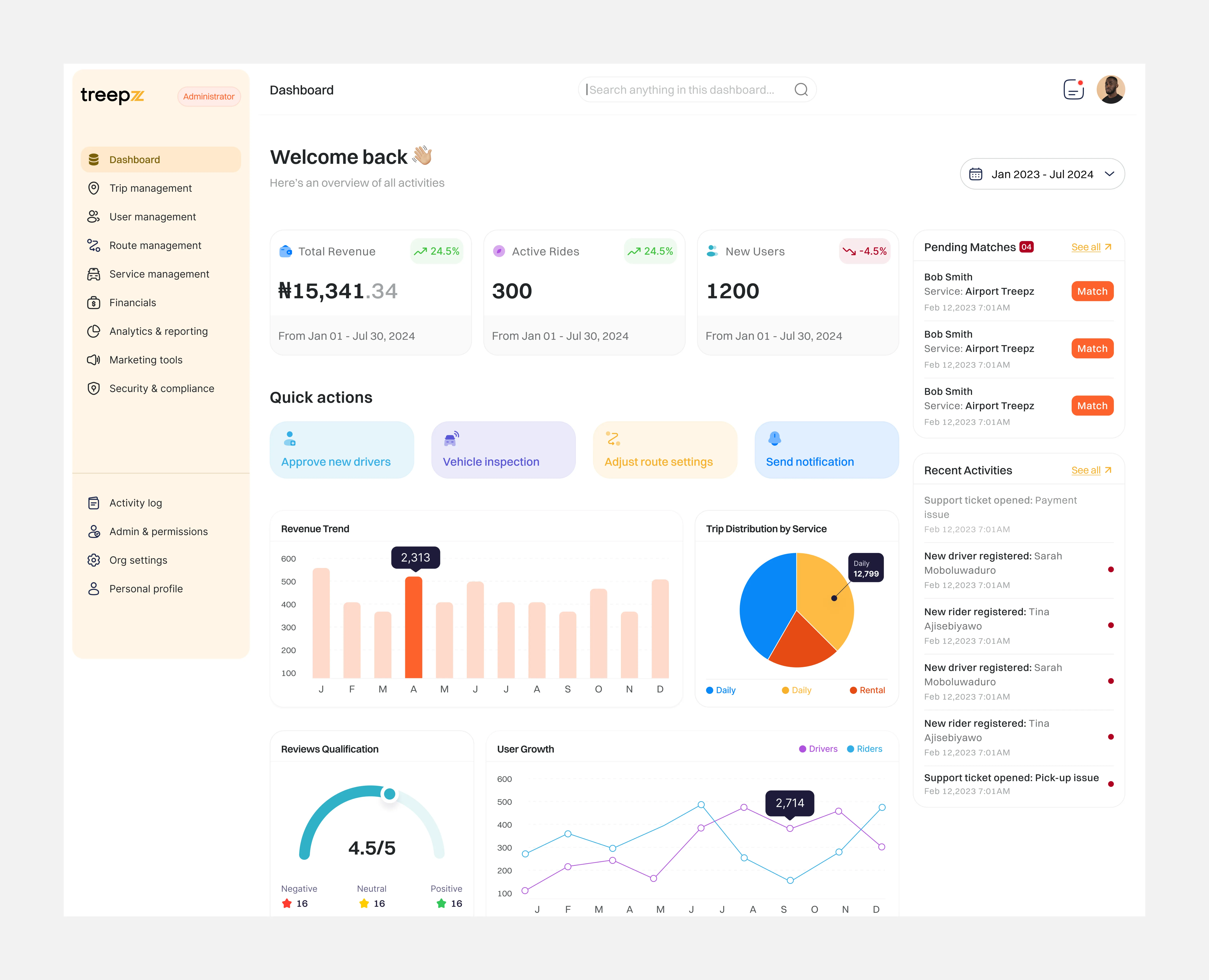
The top-level dashboard surfaces KPIs (total employees, check-ins, and check-outs) alongside a date-range selector and bar chart so HR can instantly spot trends.
Treepz Admin Console
Centralized command center enabling operations team to monitor performance across Nigeria, Ghana, Uganda, and Kenya while making data-driven decisions.
Marketing Support & Visual Design
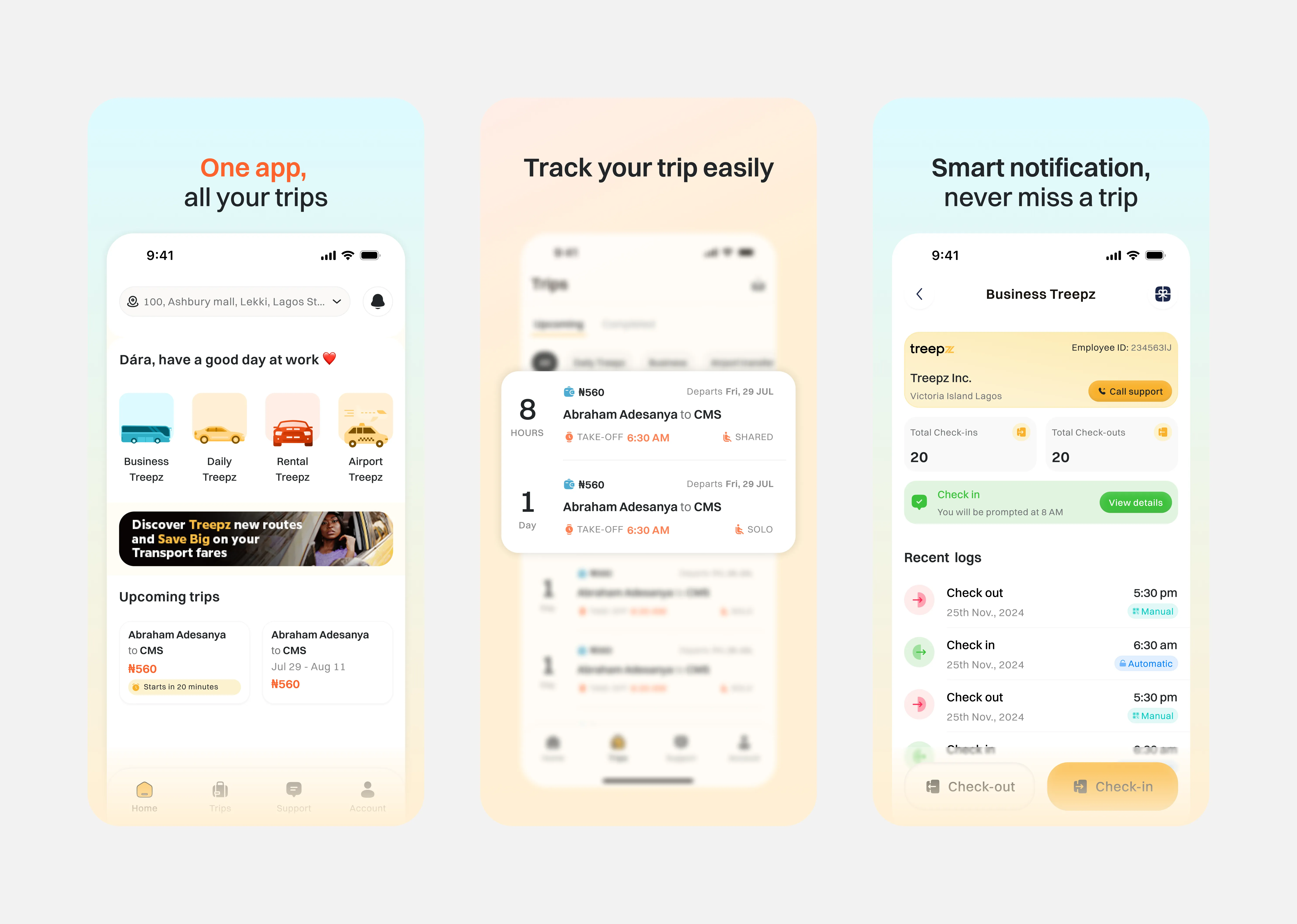
Collaborated with marketing to create Play Store banner graphics communicating the super-app concept across diverse cultural contexts.
Team & Credits
| Role | People |
|---|---|
| Product Design Lead | Matthew Obanla (led strategy, research, and team; oversaw core architecture and design system) |
| Design Team | 2 Product Designers, 1 UX Writer (team I led) |
| Key Partners | Product Management, Engineering, Data Analytics, Marketing |
This case study reflects work completed between January and August 2024 across Treepz's operations in Nigeria, Ghana, Uganda, and Kenya.